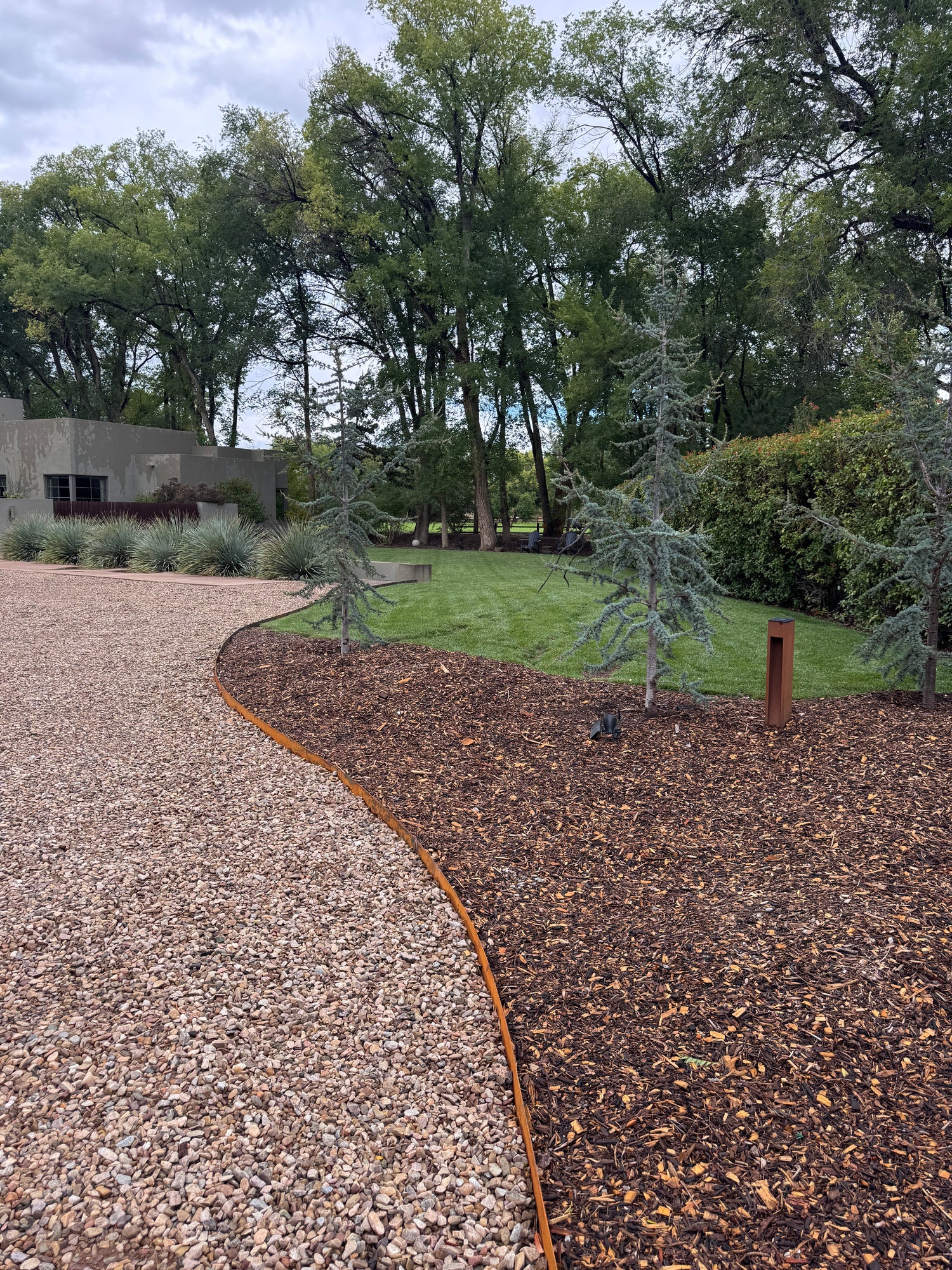


Walk through the garden center of almost any big box store and you'll find stacks of bark mulch. It has become one of the most common landscape mulches in the country.
So why don't we sell it?
The answer starts with understanding what bark is actually designed to do.
Trees Don't Want Water Sitting on Their Bark

Bark is the tree's protective outer layer.
Its job is to shield the living tissues inside the tree from weather, insects, disease, and physical damage.
Most importantly, bark helps shed water.
Rainwater isn't supposed to soak into the bark. Instead, it runs down the outside of the trunk toward the root system, where the tree actually absorbs moisture.
Water and nutrients move upward through the living tissues just beneath the bark—the cambium and sapwood—not through the bark itself.
In other words...
Bark is naturally water resistant because that's exactly what nature designed it to be.
Hydrophobic by Design
If you've ever picked up a piece of dry bark, you've probably noticed water beads up on it instead of soaking in quickly.
That's because bark is naturally hydrophobic, meaning it repels water.
This is a wonderful feature for protecting a tree trunk from rot.
It's much less beneficial when you're trying to conserve moisture in your landscape.
Here in New Mexico, every drop of water matters.
We want mulch that slows evaporation, allows irrigation water to reach the soil, and gradually holds moisture near plant roots—not one that sheds water as efficiently as possible.
Why Bark Mulch Floats Away
One of the most common misconceptions we hear is that wood mulches float away during heavy rain or irrigation.
In reality, many people are thinking of bark mulch, not true arbor chip (wood) mulch. While the two are often grouped together, they're made from different parts of the tree and perform very differently in the landscape.
Commercial bark mulch is produced by machines that strip the outer bark from logs before the wood is processed into lumber. The result is a mulch made almost entirely of lightweight bark pieces.
Because bark is naturally water resistant, those pieces tend to float during heavy irrigation or New Mexico's summer monsoon storms. They're also light enough to shift in our spring winds.
By comparison, arbor chip mulch contains a blend of wood, bark, and smaller woody materials that interlock as they settle, helping the mulch stay in place through wind and rain.
It's Not the Best Choice for an Arid Climate
Another challenge with bark mulch is how the pieces fit together.
Since bark consists mostly of large, flat flakes, the pieces tend to stack on top of one another rather than nest together.
That leaves large air pockets throughout the mulch layer.
Those spaces become attractive hiding places for pests like:
🪳 Cockroaches
🦂 Scorpions
🦗 Black crickets
While no mulch is completely bug-proof, mulches with a variety of particle sizes create a tighter, more interconnected layer that offers fewer protected spaces for unwanted pests.
Why We Prefer Arbor Chip Mulch
At Soilutions, our mulches are made from real arbor chips—the branches, trunks, and woody material produced during tree trimming.
Instead of containing only bark, arbor chip mulch includes:
-
Wood
-
Small twigs
-
Some bark
-
Ground leaves (depending on the season)
-
A variety of particle sizes
Those different-sized pieces naturally interlock and settle together.
The result is a mulch that:
✅ Stays in place better during wind and rain
✅ Conserves moisture more effectively
✅ Helps regulate soil temperatures
✅ Gradually breaks down to build healthy soil
As the mulch decomposes, it feeds the biology beneath it and becomes tomorrow's compost.
Nature Rarely Covers the Forest Floor with Only Bark
Take a walk through a forest.
You won't find the ground covered with nothing but bark.
Instead, you'll see a natural mix of wood, twigs, leaves, needles, and organic matter—all working together to protect the soil.
That's exactly the kind of mulch we try to replicate.
Rather than separating bark from wood, we believe nature already has the recipe figured out.
🌱 The Bottom Line
Bark is an excellent material for protecting a tree—but it isn't necessarily the best mulch for a New Mexico landscape. Because bark naturally repels water, floats more easily, and creates larger air pockets, it isn't as well suited to our dry, windy climate as arbor chip mulch. At Soilutions, we believe mulch should work with nature, not against it. That's why we choose natural arbor chip mulches that stay in place, conserve moisture, protect plant roots, and gradually improve the soil as they break down.